Most 12x36x4 air filters end up in the trash with two to four months of clean-air life still in them. That’s not a study estimate. That’s what we see when customers send used filters back to our U.S. manufacturing facility, and what our service team hears on real calls every week.
Filter waste is mostly a timing problem, not a filter problem. The 12x36x4 air filters sit among the best-built, longest-lasting filter sizes on the market. Deeper pleats mean more capture media per frame. Fewer boxes leave our warehouse. Fewer used filters hit the landfill every year. If the fundamentals feel hazy, a three-minute read on air filter basics will make the rest of this guide stick.
Here’s where most homeowners go wrong. They swap filters on the calendar rather than the pleats, they order the wrong nominal size, and they pick a MERV rating their blower can’t actually push air through. Fix those three habits and your replacement frequency drops by roughly a third, with no drop in the air your family breathes at home.
TL;DR Quick Answers
Biggest waste reducer: size the filter correctly and match MERV to your blower. Then change based on a monthly flashlight check, not the calendar.
Typical lifespan: six to twelve months in most homes, which is three to four times the service life of a 1-inch filter in the same slot.
Best MERV for most homes: MERV 11. Step up to MERV 13 only if your system handbook clears it.
Greenest sourcing: U.S.-made filters with cardboard frames, delivered on a subscription schedule that matches how often you actually change.
Disposal: bag the used filter at the unit, then check your city’s mixed-fiber recycling options before it goes in the trash.
Top Takeaways
A 12x36x4 lasts three to four times longer than a 1-inch in the same slot, so don’t waste that built-in head start.
Skip the calendar. Run the flashlight test once a month and let the filter tell you when it’s done.
Match your MERV rating to what your blower can actually move air through.
Seal the filter frame. Any gap lets unfiltered air slip past the media, which is waste you can’t see.
Buy U.S.-manufactured filters to cut shipping emissions and retail packaging at the same time.
Bag spent filters at the return grille before disposal, then check your local recycling options.
What Makes a 12x36x4 Air Filter Different
The dimensions break down as twelve inches tall, thirty-six inches wide, and four inches thick. That four-inch depth is where the real work happens. Because a deeper frame holds more pleated media, the filter captures more dust, pollen, and pet dander before your blower starts to strain. A properly sized air filter with deep pleats genuinely replaces three to four 1-inch filters across a year. One return grille that used to send four or five filter boxes to the landfill now sends one or two. If you’re not sure where yours lives in your system, this filter location guide walks through the most common placements.
You’ll usually find this size in whole-home systems and oversized returns that don’t fit a standard 1-inch grille. Light commercial buildings use it too. The dimensions are less common at big-box stores, so homeowners sometimes panic-buy the wrong size or fall back on cheap 1-inch stand-ins that defeat the whole point of the deeper frame. If you’re weighing 5-inch filter alternatives instead, the same rule applies: deeper pleats do more work and generate less waste.
7 Proven Ways to Minimize Waste With 12x36x4 Air Filters
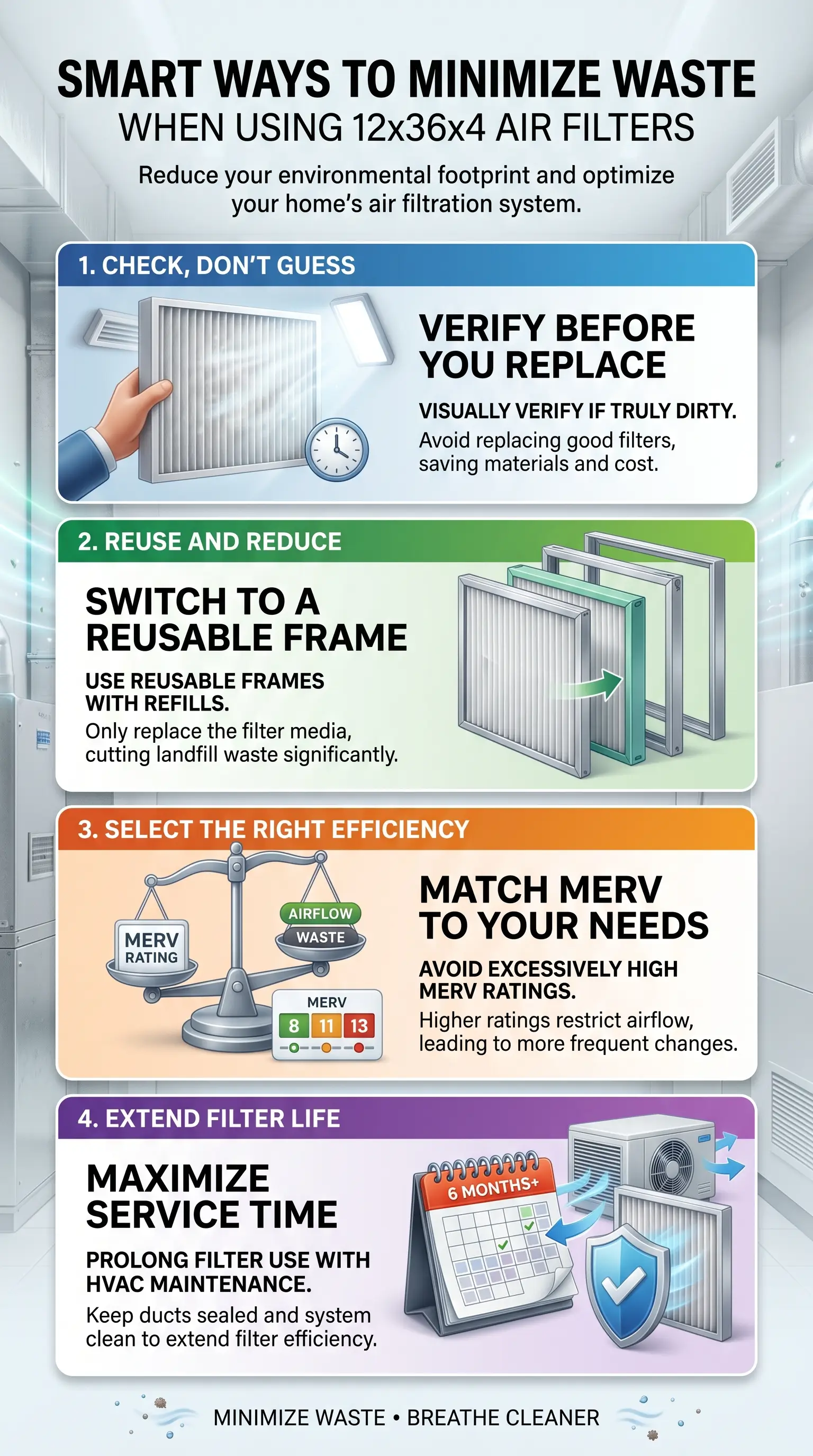
Confirm the exact size before you order. Measure your return grille, then compare that reading to the nominal size printed on the current filter. A 12x36x4 is often a custom size, and ordering the wrong dimensions is the single biggest reason filters get tossed unused. If you’re new to the process, these replacement instructions cover the basics in a few minutes.
Match MERV to your HVAC system. A higher MERV isn’t automatically better. Push a MERV 13 filter through a blower designed for MERV 8 and the filter loads faster, the motor strains, and you end up changing sooner than you should. This MERV rating guide is a good starting point for figuring out what your system actually wants.
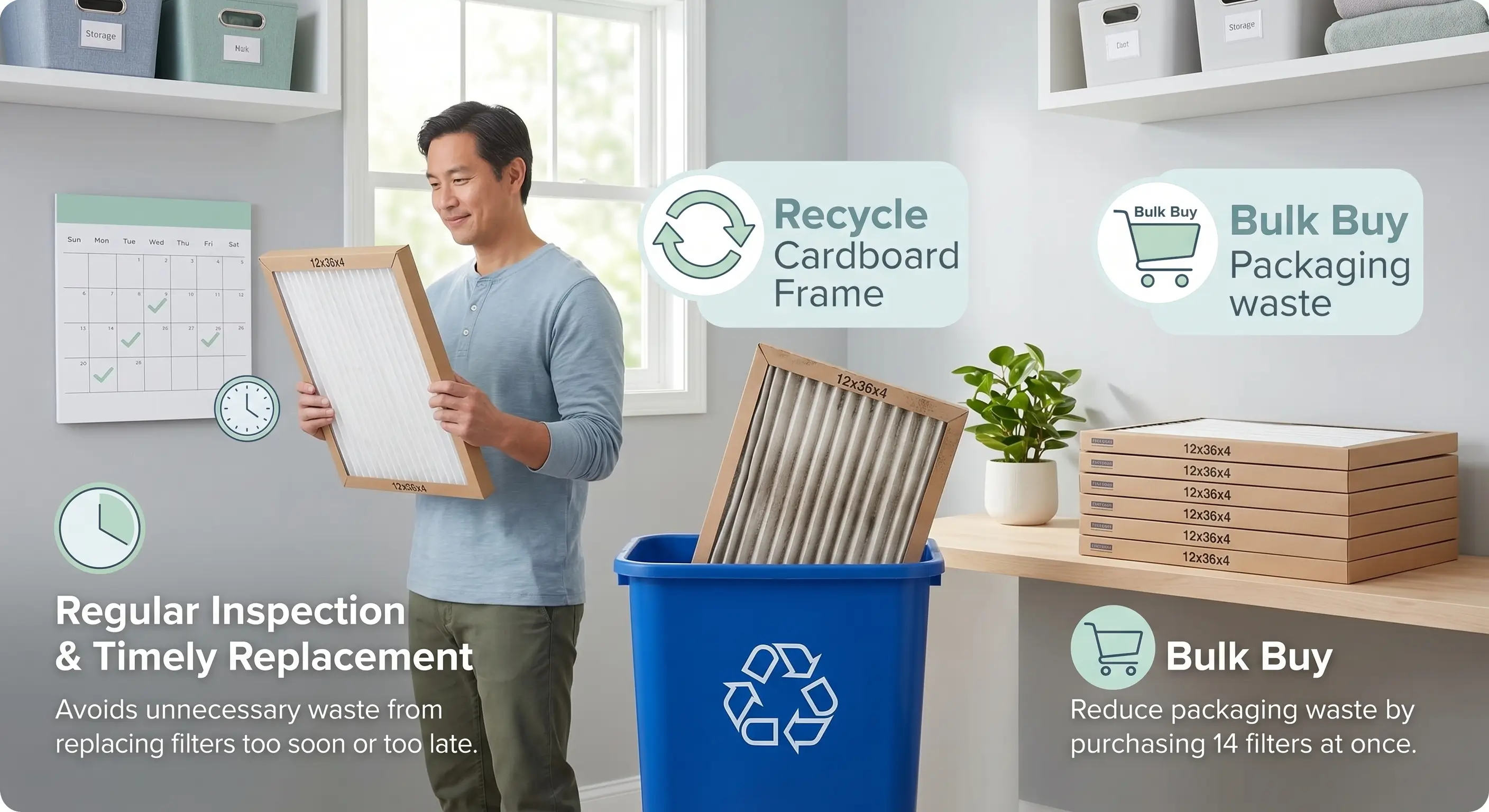
Run the monthly ‘flashlight test.’ Hold a flashlight behind the filter and look at the pleats from the front. If you can still see light coming through, the filter is still doing its job. In our experience, this one check alone adds two to four months of usable life compared to changing on a fixed calendar.
Seal the filter frame gap. A quarter-inch of space around a 12x36x4 lets unfiltered air slip around the media, which means less actual filtering and dirtier evaporator coils. Foam gasket tape gives you a snug fit. Follow these proper replacement steps when you seat the new filter so the seal holds.
Cut down on indoor dust at the source. Walk-off mats at every entry, a weekly pass with a HEPA vacuum, and regular pet grooming all lower the particle load hitting your filter. In dustier rooms, some homeowners also run dust defense filters in other returns to take some of the pressure off the 12x36x4.
Be smart about the fan setting. Running the HVAC blower on ‘ON’ twenty-four hours a day pulls air through the filter constantly, even when no heating or cooling is called for. Switch the thermostat to ‘AUTO’ and the fan only runs during actual conditioning cycles. Filter life goes up and your energy bill drops at the same time. A seasonal round of AC tune-up tips will surface other small savings you’d otherwise miss.
Dispose of used filters responsibly. Slide the filter straight into a garbage bag at the return so the captured dust stays captured. Some cardboard-framed 12x36x4 filters qualify for mixed-fiber recycling programs, so a two-minute check with your city’s waste department is worth doing before it goes in the trash.
How Long Should a 12x36x4 Filter Really Last?
Based on our customer data and in-house testing, a 12x36x4 lasts six to twelve months in a typical household. That’s roughly three to four times the service life of a 1-inch filter in the same slot. Pets, allergies, nearby construction, and wildfire smoke all pull that number toward the shorter end. Empty nesters in mild, low-pollen climates routinely stretch past the upper end.
Signs you can wait: steady airflow, clean supply vents, no new allergy flare-ups in the house. Signs the filter is actually done: visibly loaded pleats, a musty or dusty smell when the system kicks on, a noticeable drop in airflow at the vents, or an energy bill that’s higher than usual for the season. If your system is more than fifteen years old and struggles even with a fresh filter, the problem may not be the filter at all. Look at AC installation estimates alongside the filter upgrade before you spend more on consumables.
Choosing an Eco-Conscious 12x36x4 Filter
A few habits move a 12x36x4 purchase from decent to actually sustainable. Buy from a U.S. manufacturer so your filter travels fewer miles to reach your door. Look for a cardboard frame, which qualifies for more mixed-fiber recycling programs than plastic does. And set up subscription delivery on the cadence your household actually needs, not a blanket ninety days, so you aren’t paying for extra packaging across the year. When you’re comparing formats, deep-pleated options in this exact size beat thinner filters on dust-holding capacity and replacement frequency alike.
When you’re ready, shop 12x36x4 filters straight from the manufacturer. Every one is made-to-order in the U.S., ships free, and arrives in packaging sized for a single filter instead of a retail shelf pack.
“After a decade of making 12x36x4 filters and reviewing feedback from millions of customer orders, the pattern is consistent: homeowners who adopt the monthly flashlight test and right-size their MERV rating cut replacement frequency by about a third, and their indoor air quality stays exactly the same.”
Essential Resources
These are the authoritative sources we point customers to when they want to go deeper on air quality, HVAC efficiency, and responsible filter use. Every one is a non-commercial government, research, or nonprofit domain.
U.S. EPA, Indoor Air Quality Hub: https://www.epa.gov/indoor-air-quality-iaq. The core federal resource on indoor pollutants, exposure, and ventilation.
U.S. Department of Energy, Maintaining Your Air Conditioner: https://www.energy.gov/energysaver/maintaining-your-air-conditioner. Official guidance on filter maintenance and its energy impact.
ENERGY STAR, Heating and Cooling: https://www.energystar.gov/products/heating_cooling. Efficiency standards and seasonal maintenance checklists straight from the program.
American Lung Association, Indoor Air Pollutants: https://www.lung.org/clean-air/indoor-air. A health-first resource on allergens, dust, and pet dander.
National Institute of Environmental Health Sciences, Indoor Air: https://www.niehs.nih.gov/health/topics/agents/indoor-air. Peer-reviewed research on indoor exposures and respiratory health.
CDC / NIOSH, Indoor Environmental Quality: https://www.cdc.gov/niosh/indoor-environmental-quality/. Occupational and residential air-quality best practices.
3 Statistics You Should Know
Americans spend about 90% of their time indoors, where some pollutant levels run two to five times higher than outdoors. That’s exactly why filter choice and replacement discipline matter as much as they do. Source: U.S. EPA, Indoor Air Quality (Report on the Environment).
Heating and cooling buildings accounts for roughly 35% of all U.S. energy consumption, which makes it the largest single end use in the country. A properly maintained 12x36x4 filter keeps your HVAC running efficiently, and efficient HVAC takes a direct bite out of that footprint. Source: U.S. Department of Energy, HVAC, Refrigeration & Water Heating.
Air conditioning alone used about 254 billion kWh in U.S. homes in 2020, or roughly 19% of residential electricity. A clogged filter or an oversized-MERV mismatch pushes that number higher by forcing the system to work against extra resistance. Source: U.S. Energy Information Administration (EIA).
Final Thoughts and Opinion
Here’s our honest take after more than a decade of making filters. The most sustainable 12x36x4 is the one you already own, used for its full service life. Filter manufacturers (ourselves included) benefit financially when you replace more often. Your HVAC system, your utility bill, and the air going into your lungs benefit when you replace at the right time, which is almost always later than the calendar says.
The 12x36x4 is one of the few filter categories where the better product and the greener product are the same object. Pair it with a monthly flashlight check, a MERV rating your blower can handle, and a snug seal around the housing, and you’ll outperform most of the air purifiers sold this year. These smart buying tips were written for a different size, but the logic transfers directly to 12x36x4 shoppers and will flag the most common waste traps before you click buy.
Frequently Asked Questions
How often should I change a 12x36x4 air filter?
Most households change a 12x36x4 filter every six to twelve months. Homes with pets, allergies, smokers, or active construction nearby trend toward the shorter end. Smaller households in mild climates often stretch well past twelve. Run the flashlight test once a month and let the filter tell you directly.
Is 12x36x4 a standard air filter size?
It’s less common than 16x25x1 or 20x20x1, and most retailers classify it as oversized or custom. Big-box stores don’t usually carry it. Specialty manufacturers make it to order in the U.S. instead. If you manage a smaller rental unit, you may actually need apartment air filters in more standard dimensions.
Can I wash or reuse a 12x36x4 pleated filter?
No. Standard 12x36x4 pleated filters are made to be disposed of. Washing ruins the electrostatically charged media and compresses the pleats, and the filter loses most of its capture efficiency even when it looks clean to the eye. If reusability is the priority, look into reusable filter alternatives designed for repeated cleaning.
What MERV rating is best for a 12x36x4 filter?
MERV 8 is a solid baseline for general household dust and lint, and these MERV 8 options work well for most homes. MERV 11 fits households with pets or mild allergies. MERV 13 filters go further and capture finer particles including many bacteria and smoke aerosols, as long as your blower can move air through them without strain. Always check your system’s specs before stepping up a tier.
How do I dispose of a used 12x36x4 filter responsibly?
Slide the filter into a trash bag at the return grille before you pull it all the way out, so the captured dust doesn’t end up on your floor. Seal the bag and check with your local waste authority. Some cardboard-framed filters qualify for mixed-fiber recycling. Most residential trash programs only accept them as landfill waste. When you’re shopping for a replacement, comparing marketplace filter listings against direct-from-manufacturer pricing is an easy way to avoid overpaying.
Ready for Cleaner Air and Less Waste?
Stop guessing, and stop tossing filters that still have months of service left in them. Order a made-in-the-USA 12x36x4 sized precisely for your return grille, shipped on the schedule that matches how you actually live in your home. Tap below, order the right size, and we’ll handle the rest.
Learn more about HVAC Care from one of our HVAC solutions branches…
Filterbuy HVAC Solutions - Miami FL - Air Conditioning Service
1300 S Miami Ave Apt 4806 Miami FL 33130
(305) 306-5027
https://maps.app.goo.gl/Ci1vrL596LhvXKU79